
Your plants might be suffering right now. Find out what temperature range actually keeps them thriving.
Getting your terrarium temperature right is one of the most important things you’ll do as a keeper. And honestly, it’s one of the easiest things to get wrong without even realizing it.
A lot of beginners set up their enclosure, add their plants or animals, and never think twice about the heat. But temperature affects everything inside, like how well your plants photosynthesize or even how safely your reptile digests its food.
The scary part? Your terrarium can look totally fine on the outside while the conditions inside are slowly stressing out everything living there. That’s why checking regularly makes all the difference.
So let’s break it down together. What temperatures are actually safe, what signs tell you something’s off, and what you can do to fix it before any real damage is done.
Why temperature matters more than you think
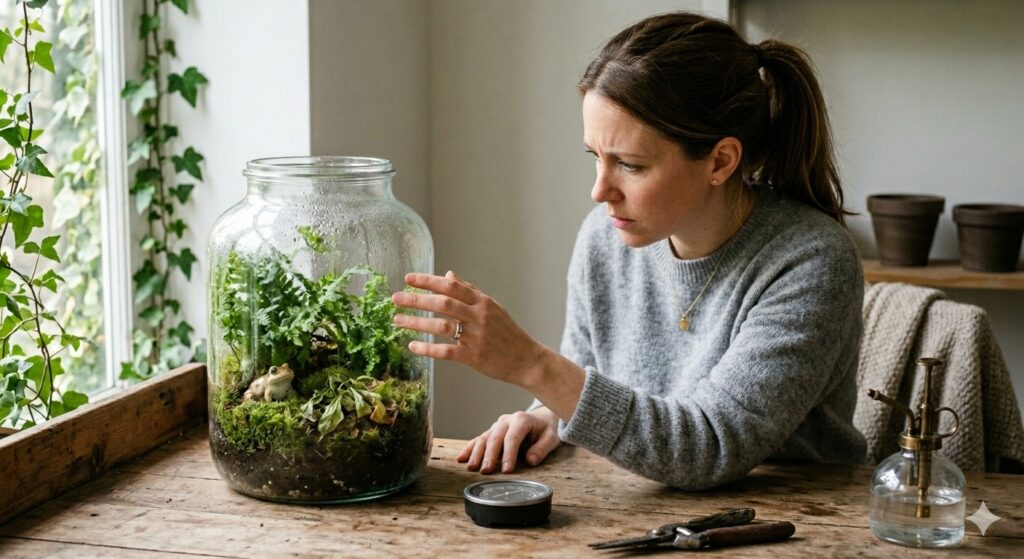
Temperature isn’t just about comfort. It controls almost every biological process that happens inside a terrarium, like root development and bacterial activity in the substrate or even digestion, immune response, and hydration in animals.
Think of it like a chain reaction. When the temperature drops too low, metabolism slows. Plants stop absorbing nutrients efficiently, and animals can become lethargic or stop eating altogether.
On the flip side, too much heat speeds things up in all the wrong ways. Bacteria multiply faster, moisture evaporates too quickly, and stress hormones in animals go through the roof.
The difference between ambient and surface temperature
Ambient temperature refers to the air temperature inside your terrarium. Surface temperature, on the other hand, is what your substrate, branches, or basking spots actually feel like when touched.
Both matter, and they’re often very different numbers. A basking rock under a heat lamp can reach 45°C (113°F) while the ambient air sits at a comfortable 27°C (80°F). Knowing both helps you understand the full thermal picture of your enclosure.
Why gradients are your best friend
A thermal gradient means having a warmer side and a cooler side inside the terrarium. This setup gives your animals the ability to self-regulate their body temperature, which is something they absolutely need to do in the wild.
Without a proper gradient, animals have nowhere to escape if they overheat and that’s genuinely dangerous. Even plants benefit from slight temperature variation, as it mimics the natural drop that often happens at night in their native habitats.
What’s considered too hot?
For most tropical terrariums, temperatures above 32°C (90°F) start entering risky territory. Desert setups can handle more heat in the basking zone, but the cool side still needs to stay manageable, usually below 30°C (86°F).
When it’s too hot, you’ll often notice plants wilting, yellowing, or dropping leaves rapidly. Animals may press themselves against the glass, breathe with their mouths open, or become unusually still. Terrarium temperature spikes can happen faster than you’d expect, especially during summer or if your heat source malfunctions.
Signs of heat stress in plants
Leaf curling is usually the first thing you’ll notice when a plant is too hot. The leaves roll inward or downward as the plant tries to reduce the surface area exposed to the heat.
Brown, crispy leaf tips come next, especially on the edges, where moisture evaporates fastest. If you spot rapid soil drying or see your moss pulling away from surfaces, that’s a strong sign the enclosure is running too warm.
What’s considered too cold?
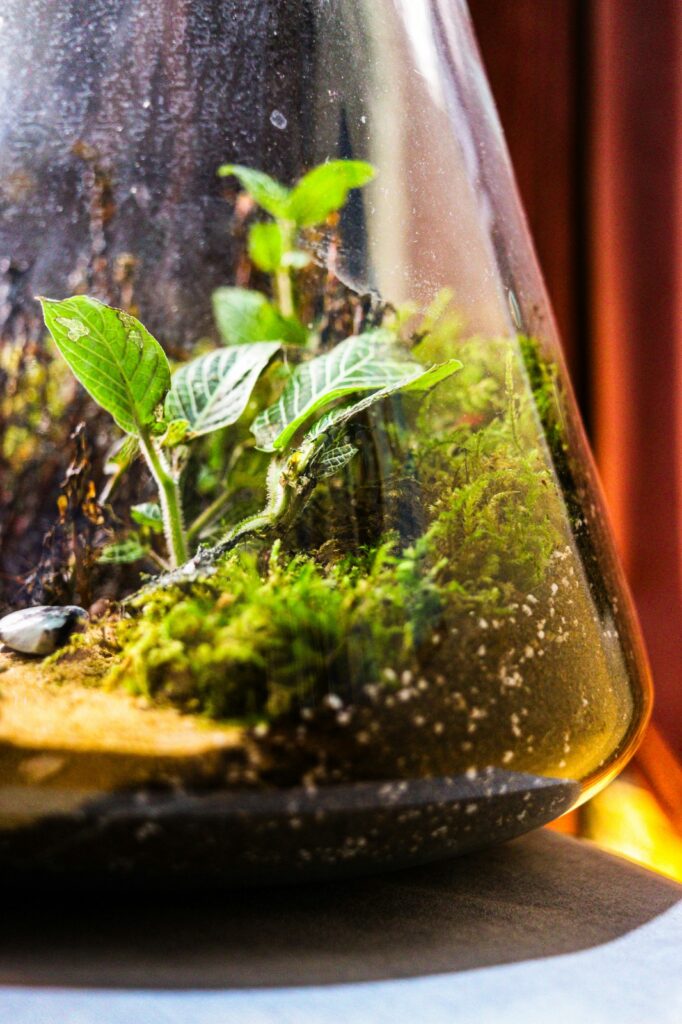
Cold is just as dangerous as heat, and in some ways harder to spot at first. For most tropical species, temperatures below 18°C (64°F) start causing issues and anything below 15°C (59°F) can be genuinely life-threatening for warm-climate animals.
Terrarium temperature that’s too low leads to a kind of biological slowdown. Plants go dormant or start to rot at the roots. Animals stop digesting, stop moving, and become highly vulnerable to respiratory infections particularly in humid setups where cold and moisture combine.
Signs of cold stress in plants
Yellowing from the base upward, combined with soft or mushy stems, usually points to cold root damage. The soil may also hold moisture for far too long, which leads to root rot even in plants that normally tolerate damp conditions.
Slow growth that doesn’t match the season, especially paired with pale coloring, can also indicate the enclosure is too cool. Many tropical plants need consistent warmth to maintain their lush appearance.
How to measure terrarium temperature properly
You can’t fix what you don’t measure and a single thermometer placed on the glass outside your enclosure won’t cut it. You need data from inside, at multiple points. Terrarium temperature varies significantly between the top, middle, and bottom of the enclosure.
The most practical setup is to use two or three digital thermometers with probes placed at different heights and on different sides of the tank. If you have animals with a basking spot, a temperature gun (infrared thermometer) lets you check surface temperatures instantly without disturbing anything.
Choosing the right thermometer
Analog thermometers look nice but they’re notoriously inaccurate for terrarium use. Stick-on strips are even worse. They measure the glass surface, not the actual air inside.
Digital probe thermometers are your best bet. Look for ones that display both current and min/max readings. That way, you can see how far temperatures swung overnight without having to babysit the enclosure around the clock.
Setting up a temperature monitoring routine
Check your temperatures at least twice a day, once in the morning and once in the late afternoon when ambient room temperatures peak. Log the readings for a week or two after any changes you make to your heating setup.
Consistency matters more than perfection. A stable terrarium temperature that stays within a safe range is far better than one that hits the ideal number once a day but swings wildly the rest of the time.
Common heating and cooling solutions
There are several tried-and-true ways to manage temperature inside a terrarium, and the right choice depends on your setup, your species, and your budget.
| Method | Best for | Notes |
|---|---|---|
| Radiant heat panel | Large enclosures | Even heat distribution |
| USB fan | Overheating in summer | Increases air circulation |
| Thermostat controller | Any heating device | Essential for temperature precision |
Always pair any heating element with a thermostat. Running a heat source without one is like leaving your oven on with no timer, eventually, something’s going to burn.
A thermostat keeps terrarium temperature within your target range automatically, even when room conditions change.
Adjusting for seasonal changes
Room temperatures change with the seasons, and so does the temperature inside your enclosure, sometimes dramatically. During summer, a terrarium that’s perfectly calibrated in winter can overheat without any changes to your setup at all.
Similarly, in winter, heat loss through thin glass can push temperatures below safe ranges overnight. These are the moments when a reliable thermostat and a spare heating element become invaluable.
Terrarium temperature management isn’t a “set it and forget it” situation, it needs seasonal recalibration. Keep an eye on weather forecasts, especially during heat waves or cold snaps.
If your home regularly gets above 30°C (86°F) in summer, you might need to add a small fan or move the enclosure to a cooler room. If winters dip hard, extra insulation around the sides of the tank can help significantly.
A word on nighttime temperature drops
In nature, temperatures drop at night and many species actually depend on that drop to regulate their circadian rhythms, digestion, and even reproduction. So a small nighttime temperature dip inside your terrarium isn’t always a problem.
For most tropical species, a drop of around 5°C (9°F) at night is perfectly fine and for some, it’s actually beneficial. The key is that the temperature should still stay within a safe minimum. Terrarium temperature shouldn’t fall below your species’ lower threshold, even at night.
If you need to maintain nighttime warmth without adding light, a ceramic heat emitter on a thermostat is an excellent solution. It keeps the heat going after your basking bulb shuts off, without disrupting your animal’s natural light-dark cycle.
Also worth reading: terrarium condensation
If you’ve been paying attention to temperature, you’re already halfway to understanding condensation, because the two are closely linked. When warm, humid air meets a cooler glass surface, water droplets form.
But how do you know if that’s a sign of a healthy terrarium or a warning that something’s off? That’s exactly what the article “Terrarium condensation: too much or just right?” digs into.
It walks you through the difference between healthy moisture cycling and the kind of excess condensation that leads to mold, root rot, and poor air quality inside your enclosure.
We’d really encourage you to give it a read, especially if you’ve just been working on dialing in your temperatures, because adjusting heat will almost always affect your humidity and condensation levels too.
Head over to that article next and get the full picture on what your terrarium’s moisture is actually telling you. It’s the kind of complementary knowledge that makes you a much more confident and capable keeper overall.