
Find out which plants are actually made for life behind glass!
The right closed terrarium plants is the single most important item to choose when building your first terrarium. Everything else supports the plants, so if the plants are wrong for the environment, the whole thing struggles.
A closed terrarium creates its own little climate. Moisture stays trapped inside, humidity stays high, and the air barely moves. That sounds cosy, and for the right plants it absolutely is.
There is a whole category of plants that genuinely thrive in exactly that kind of environment. They love high humidity, tolerate low light, and stay compact enough to share a glass container without taking it over within a few weeks.
In this article, you will find the most reliable options for beginners. By the end, you will have a clear shortlist to work with and a much better chance of building something that actually lasts.
What to look for before you pick a plant
Before getting into the specific picks, it helps to understand what all the best closed terrarium plants have in common. As a general rule, you are looking for species that naturally come from humid, shaded forest floors.
Some plants need airflow. Some will rot at the roots if kept consistently damp. And some simply grow too fast and will crowd out everything else before you have had a chance to enjoy the build.
Generally speaking, the best candidates share a few key traits. They should be slow to moderate growers, comfortable with indirect or filtered light, and genuinely happy in high-humidity conditions. There is a real difference between a plant that survives and one that thrives.
Size matters too. Miniature or slow-growing varieties are far easier to manage inside a closed container. If a plant outgrows its space, you either have to trim it constantly or tear the whole thing apart to replant, neither of which is ideal when you are just starting out.
Quick comparison of beginner-friendly picks:
| Plant | Light needs | Humidity tolerance | Growth rate |
| Nerve plant (Fittonia) | Low to medium | Very high | Moderate |
| Baby tears (Soleirolia) | Low to medium | Very high | Fast |
| Mosses (various) | Low | Very high | Slow to moderate |
| Miniature peperomia | Low to medium | High | Slow |
| Prayer plant (Maranta) | Low to medium | High | Moderate |
With that in mind, here are the top picks for closed terrarium plants that beginners consistently find the easiest to work with. Each one is widely available, forgiving to care for, and well-suited to the humid, low-light conditions a sealed glass container naturally produces.
The best plants for your closed terrarium
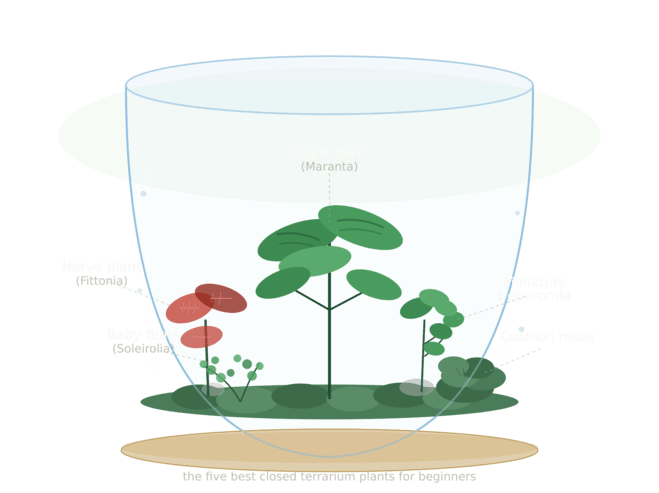
The options below cover a range of textures, colours, and growth habits, so you can mix and match to create something visually interesting without accidentally combining plants that have totally different care needs.
Nerve plant (Fittonia)
Fittonia is arguably the most popular terrarium plant for good reason. Its striking patterned leaves look incredible behind glass, and it genuinely loves the humid, enclosed conditions a closed setup provides.
It stays compact, tolerates low light extremely well, and comes in several colour varieties — green, red, white, and pink — giving you real flexibility when planning your overall terrarium aesthetic.
Baby tears (Soleirolia soleirolii)
Baby tears is one of those closed terrarium plants that seems almost purpose-built for the job. It creeps softly across the substrate, filling gaps beautifully without ever becoming aggressive or overwhelming neighbouring plants.
It grows best in consistently moist conditions and filtered light, two things a sealed terrarium provides naturally. Moreover, it adds a soft, carpet-like texture that makes the whole build look lush and full.
Miniature peperomia
Peperomia comes in dozens of varieties, and the smaller ones are genuinely excellent for closed terrariums. They are slow-growing, store moisture in their leaves, and handle the humidity without any sign of rot.
Look specifically for Peperomia rotundifolia or Peperomia prostrata. Both stay small, trail attractively over rocks or driftwood, and add a different leaf texture that contrasts beautifully with moss or Fittonia nearby.
Mosses
No list of closed terrarium plants would be complete without moss. It is, in many ways, the foundation of the whole aesthetic: soft, green, and perfectly at home in a humid, sealed environment.
Sheet moss, cushion moss, and mood moss are all excellent choices. They require very little light, thrive on consistent moisture, and create that lush forest-floor look that makes closed terrariums so visually satisfying and appealing.
A few plants to avoid in closed builds
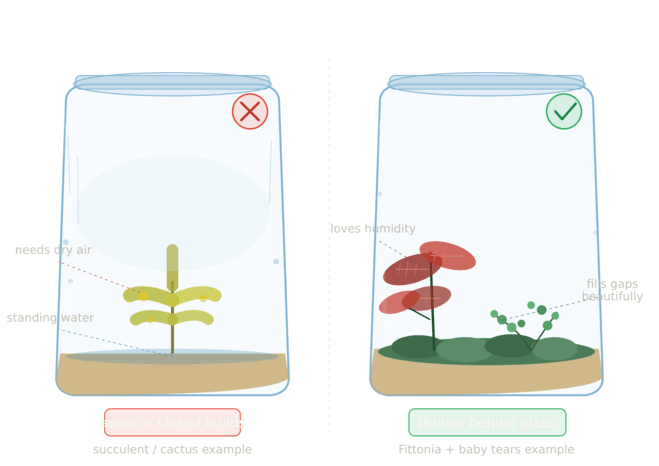
Knowing what not to plant is just as useful as knowing what works. Succulents and cacti, for instance, are almost always a bad idea in a closed terrarium. They need dry conditions and good airflow, which is the exact opposite of what a sealed glass container provides.
Similarly, fast-growing plants like pothos or common ivy will quickly take over the space and choke out everything else.
They might look manageable at first, but within a few weeks they will dominate the container and become more of a maintenance problem than a pleasure to look at.
Plants to avoid in closed setups
- Succulents and cacti: need dry air and low humidity
- Pothos and fast-growing vines: outgrow the space too quickly
- Orchids: require airflow and drying periods between watering
- Most herbs: prefer direct light and dry soil conditions
- Peace lilies: grow too large and need more root space than most containers allow
In short, stick with species that naturally live on shaded, humid forest floors, and you’ll not go far wrong. The right closed terrarium plants are not hard to find, they just need to match the environment you are creating, rather than fighting against it every single day.
How to combine plants for a better result
Once you have your shortlist, think about how the plants will look together rather than just picking your favourites. A good combination usually includes one low carpeting plant like baby tears or moss, one upright plant for height, and one with interesting leaf colour or texture for contrast.
Avoid overcrowding. It’s tempting to fill every gap, but plants in a closed terrarium grow, and they need a little breathing room to do so without fighting each other. A slightly sparse build at the start will look full and lush within a few weeks as everything settles in.
Also, think about scale. Everything in a closed terrarium looks bigger once the lid goes on, so plants that seemed modest in the shop can feel quite dominant inside the container. When in doubt, go smaller! You can always add more later if the space feels too open.
Keep going: what to read next
Now that you have your plant list sorted, the next step is making sure the foundation underneath them is built correctly. That part matters far more than most beginners expect it to.
How to layer terrarium soil like a pro walks you through every single layer, from drainage gravel to substrate, and explains exactly what each one does for your plants and build.
It’s the perfect companion to everything you just read here because even the best plants will struggle if the soil system underneath them is not set up properly from the start.
Head over and check it out before you start building. A little extra reading at this stage will save you a lot of troubleshooting later and make the whole process far more enjoyable.